
Sign up now to get 7 Day Free Trial

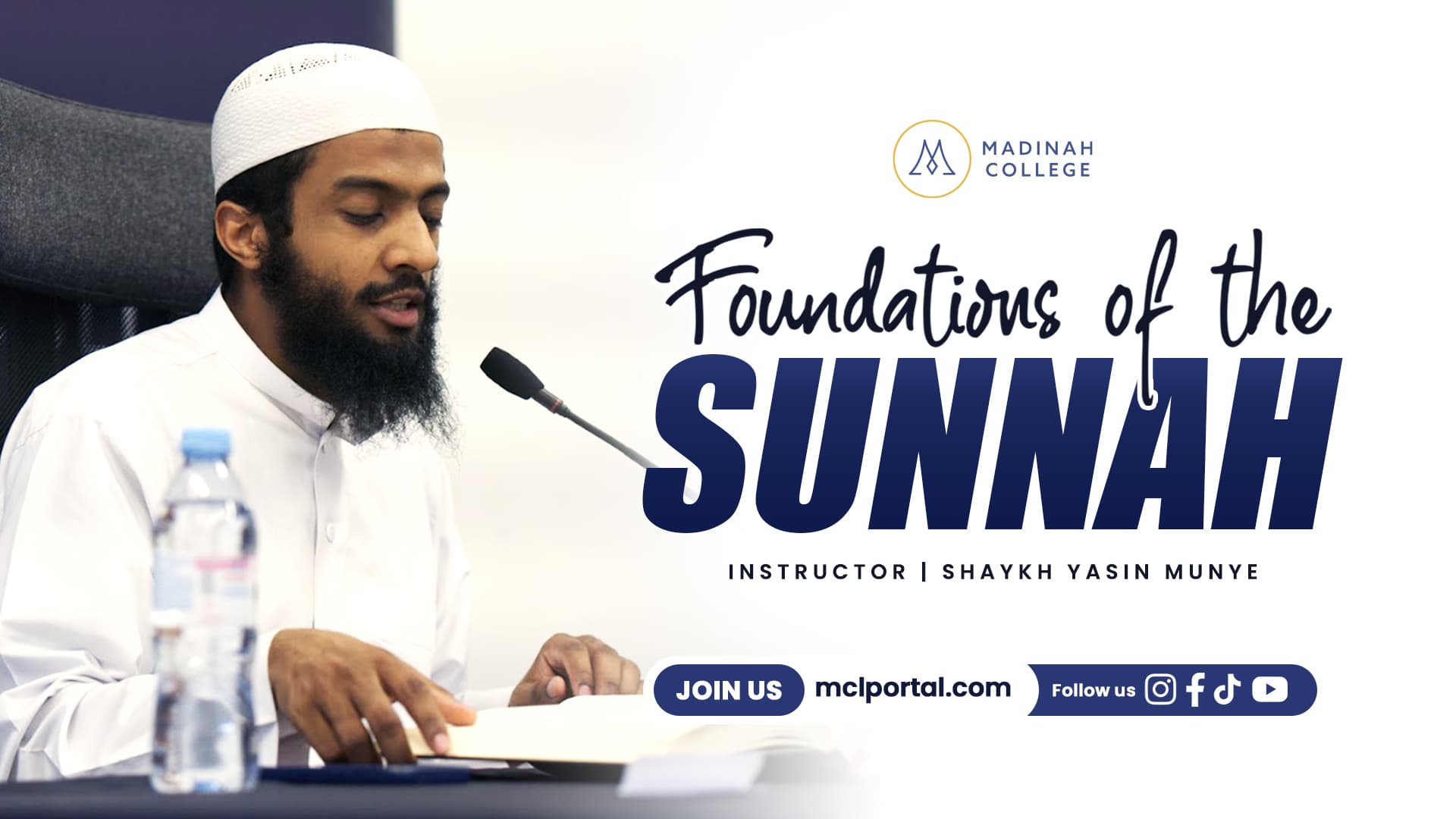
Foundations of the Sunnah—a vital study that grounds students in the principles, authority, and correct understanding of the Sunnah of the Messenger of Allah ﷺ. The course clarifies the central role of the Sunnah in Islamic belief and practice, and addresses common misconceptions that lead to confusion, neglect, or misapplication.

Taught by Shaykh Yāsīn Munye, the course combines sound scholarly methodology with practical guidance, helping students appreciate the Sunnah as a lived tradition that shapes belief, worship, character, and daily conduct.

Students will learn:

• The definition and scope of the Sunnah in Islam

• The Sunnah’s relationship to the Qur’an and its role in legislation

• The obligation of following the Sunnah and the dangers of abandoning it

• How the early generations preserved, understood, and implemented the Sunnah

• Common misunderstandings surrounding hadith and scholarly differences

• Practical ways to revive adherence to the Sunnah in everyday life

The course is delivered by Shaykh Yāsīn Munye, a graduate of King AbdulAziz University in Arabic Language and Islamic Studies. He memorised the Qur’an prior to his formal studies and holds ijāzah in Ḥafṣ and Sūsī. He has studied under distinguished scholars in Makkah, including Shaykh Wasiullah Abbas and Shaykh Muhammad Adam Ethiyopi, from whom he received ijāzah in Ṣaḥīḥ al-Bukhārī. He has also attended intensive seminars on classical Islamic texts under Shaykh Salih al-Osaymee and is currently pursuing a Master’s degree. Alongside his studies, he teaches Fiqh and Qur’an, blending traditional scholarship with contemporary learning.

An essential course for anyone seeking a firm grounding in the Sunnah and a clear, balanced approach to practicing Islam upon authentic guidance.

Course Content

  1. Introduction🔒
  2. Author Imam Ahmad🔒
  3. 1. Adhering to what the Companions were upon🔒
  4. 2. And leaving Innovations🔒
  5. 3. Leaving Disputes🔒
  6. 4. Sitting with people of desire🔒
  7. 5. Sunnah is the narrations🔒
  8. 6. Sunnah explains the Quran🔒
  9. 7. No Analogy in the Sunnah🔒
  10. 8. Belief in the Qadr🔒
  11. 9. He does not dispute with anyone-🔒
  12. 10. And the Quran is the Words of Allāh,🔒
  13. 11. And beware of debating the one who innovates in this issue-🔒
  14. 12. And the belief in the Ruyah🔒
  15. 13. And that the Prophet (sallAllāhu alayhi wa sallam) verily saw his Lord🔒
  16. 14. And the belief in the Mīzān🔒
  17. 15. . And that Allāh will speak with the slaves🔒
  18. 16. And the belief in the Hawd-🔒
  19. 17. And the belief in the punishment of the grave🔒
  20. 18. And the belief in the intercession of the Prophet🔒
  21. 19. And the belief in that Al-Masīh Ad-Dajjāl-🔒
  22. 20. And that ‘Īsā ibn Maryam will kill Dajjal🔒
  23. 21. And that Īmān is in speech and deeds🔒
  24. 22. Whoever leaves the Salah is a Kaafir🔒
  25. 23-27. The best of the Ummah after the Prophet🔒
  26. 28-34. Obeying the Leader and not Rebelling🔒
  27. 35. And fighting against thieves🔒
  28. 36-40. The Righteous and the Sinner🔒
  29. 41. And the one who commits zinā🔒
  30. 42. And whoever criticizes anyone from the Companions🔒
  31. 43-44. And nifāq (hypocrisy) is- kufr🔒
  32. 45. and Paradise and Hellfire🔒
  33. 46. Conclusion🔒